

Natural Gas (Development Surcharge) (Amendment) Act, 2026
Published On 24 Aug, 2026
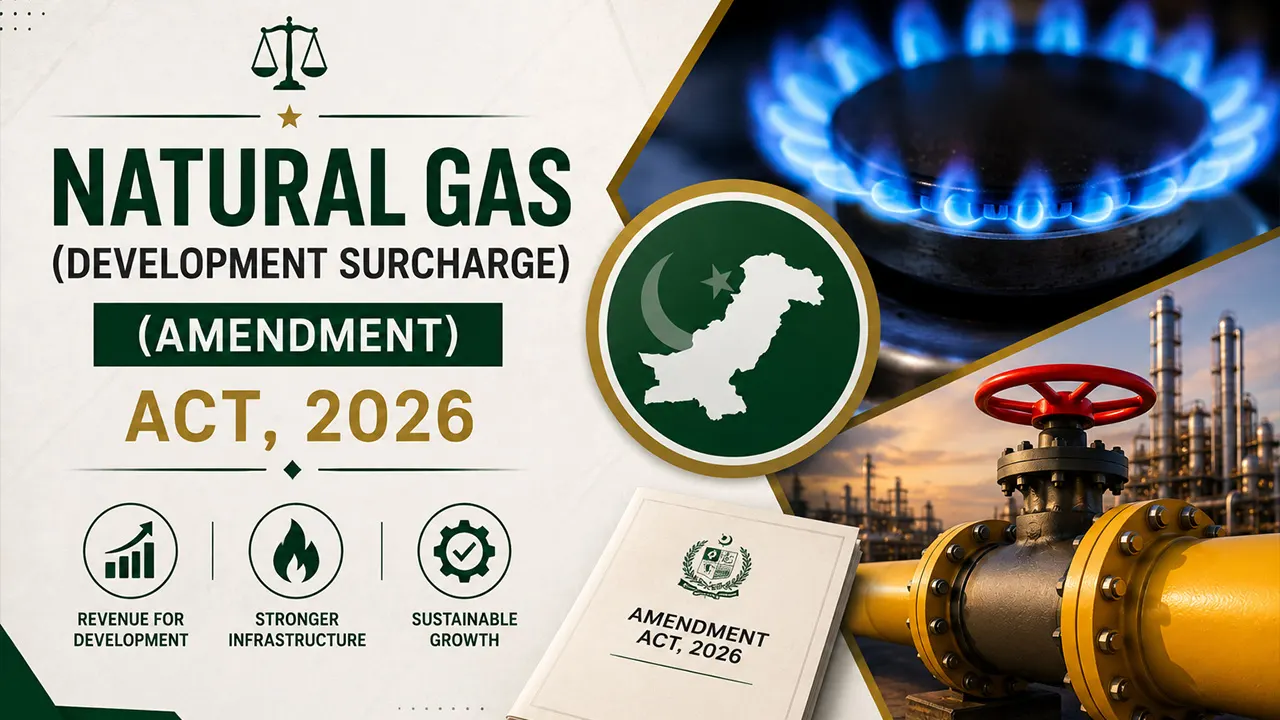
Pakistan’s National Assembly has Passed the Natural Gas (Development Surcharge) (Amendment) Act, 2026 to amend the Natural Gas (Development Surcharge) Ordinance, 1967, clarify gas pricing definitions, revise development surcharge calculations, and strengthen recovery and enforcement mechanisms.
The amendment seeks to align the existing law with the current regulatory framework under the Oil and Gas Regulatory Authority (OGRA), address issues related to differential margins, and improve the collection of natural gas development surcharge.
What Changed Under the New Law?
Definitions Under the Ordinance Updated
The amendment introduces and revises several definitions in Section 2 of the Natural Gas (Development Surcharge) Ordinance, 1967.
A new definition of “Authority” refers to the Oil and Gas Regulatory Authority established under the OGRA Ordinance, 2002.
The amendment also updates definitions relating to:
• Sale price
• Late payment surcharge
• Natural gas
• Negative differential margin
• OGRA Ordinance
• Prescribed price
Natural Gas Development Surcharge Mechanism Revised
Section 3 has been amended to provide that every company shall collect and pay to the Federal Government a development surcharge equal to the differential margin on natural gas sold to consumers, in the manner prescribed by rules.
The amendment also introduces provisions for situations where a negative differential margin emerges.
Under the revised mechanism:
• The development surcharge will not become payable when a negative differential margin emerges
• Companies will recalculate their surcharge liability after the final tariff adjustment
• The final surcharge collection status will be reassessed
• The differential margin will be deposited into the government treasury within one month of determination of final revenue requirements by OGRA
• Negative differential margins may be adjusted against available differential margins
• Any remaining negative differential margin may be carried forward to the next financial year
Notice of Default and Gas Disconnection Rules Revised
Section 5 has been replaced with new provisions dealing with consumers who fail to pay the development surcharge.
Where a consumer defaults for a continuous period of six months, the company must issue a notice requiring payment of the default amount along with the late payment surcharge within one month.
If the consumer fails to make the required payment, the natural gas supply may be disconnected.
Partial Payment Provision Introduced
The amendment provides an opportunity for restoration of gas supply where the consumer pays 60 percent of the default amount, along with the late payment surcharge, within six months of receiving the default notice.
The remaining 40 percent must then be paid within 30 days.
If the required payments are not made, the gas supply will remain disconnected until the default amount and late payment surcharge are paid.
Schedule of Companies Updated
The amendment also makes changes to the Schedule of the Ordinance.
These include:
• “Northern” replaced with “Southern” in entry 2
• “Gas Company” replaced with “Energies” in entry 3
• Entry 5 replaced with Oil and Gas Development Company Limited (OGDCL)
Why Was the Law Introduced?
According to the Statement of Objects and Reasons, the Natural Gas (Development Surcharge) Ordinance, 1967 was introduced to provide for the levy and collection of development surcharge on natural gas based on the differential margin between the prescribed price and sale price.
The gas sector’s regulatory and pricing framework has evolved over time, particularly following the establishment of OGRA, which now determines and notifies gas sale prices and revenue requirements.
The government identified several issues in the existing law, including unclear definitions, the absence of adequate provisions for negative differential margins, recovery of accumulated surcharge, late payment surcharge, and enforcement measures for persistent defaults.
What Does the Amendment Aim to Achieve?
The legislation seeks to:
• Align the law with the prevailing gas regulatory framework
• Clarify definitions related to gas pricing
• Establish a mechanism for negative differential margins
• Improve collection of natural gas development surcharge
• Provide a clear recovery mechanism for defaulting consumers
• Strengthen enforcement through gas supply disconnection
• Provide a mechanism for partial payment and restoration of gas supply
• Update the list of companies covered under the Schedule
• Address anomalies in the existing legal framework
Key Provisions of the Amendment
• The Natural Gas (Development Surcharge) (Amendment) Act, 2026 is introduced
• The Natural Gas (Development Surcharge) Ordinance, 1967 is amended
• OGRA is formally referenced as the relevant Authority
• Definitions of sale price and prescribed price are updated
• Rules for negative differential margins are introduced
• Development surcharge collection and adjustment procedures are revised
• Six-month default provisions are introduced for consumers
• Gas supply may be disconnected for non-payment
• Consumers paying 60 percent of the default amount may qualify for restoration subject to the prescribed conditions
• The remaining 40 percent must be paid within 30 days
• The Schedule of companies is updated
• The Act comes into force immediately
Pakistan’s National Assembly has introduced the Natural Gas (Development Surcharge) (Amendment) Act, 2026 to modernize the legal framework governing natural gas development surcharge, clarify pricing and differential margin mechanisms, strengthen recovery procedures, and align the law with the prevailing regulatory framework under OGRA.